Discussion of H. J. Res. 161, 1917-09-24
Text of H. J. Res. 161, 1917-09-29
The patent itself, 1917-11-06
In the Army and Navy Journal, 1917-11-24
In The Outlook, 1917-12-26
Jewelers surprised, 1917-11-28
Regarding paper products, 1918-01-01
Lawsuit against Wagner-Gilger-Cohn, April 1918
Wagner-Gilger-Cohn settles, 1918-04-17
Congress realizes the patent issue, 1918-01-09
The Outlook again, 1918-02-06
R. L. Queisser’s early biography, 1914
Queisser’s speech to the Ohio Society, November 1918
Queisser’s posthumous biography, 1939-06-01
See also:
Design and display of the service flag
From the Congressional Record of the 65th Congress, 1917-09-24, pages 7385–7386:
On page 7386:Mr. Emerson: Mr. Speaker, I ask unanimous consent to address the House for two minutes.
[No objection.]
Mr. Emerson: Mr. Speaker and gentlemen of the House, on my house in Cleveland hangs a service flag given me by Capt. R. L. Queisser, the designer of this flag.
The flag may be of any size, with a red border and a white center, with stars in the center to indicate the number from that household or place of business that are in the service of the United States during this war.
This service flag has been adopted by Hon. Harry L. Davis, mayor of Cleveland, the Cleveland Chamber of Commerce, East Cleveland City Council, and by the governor of Ohio. The flag is displayed in many homes and factories in Cleveland and all over the United States.
The Cleveland Trust Co. and the Guardian Trust Co., two of the largest banks in Cleveland, have this service flag displayed. There is nothing to do but to have Congress ratify what has been accepted by the people of this country as a proper service flag.
I am certainly proud of the fact that my only son is now in the service of the United States, not as an officer but as a private. I know that every family in Cleveland and all over the United States that have a member of the family in the service would be proud to display this flag. The Government should give one to every family that have sons or daughters in the service.
In these closing days of this extra session let us pass this resolution and give the fathers and mothers of this country, who give their sons and daughters freely to this great cause, some recognition, so that the world may know as it passes those families who gave to this great cause of liberty. We give a button to those who buy a liberty bond. Why not give a flag to those who are willing to give their own flesh and blood; the dearest thing in all the world to a father and mother—their children? [Applause.]
By Mr. EMERSON: Joint Resolution (H. J. Res. 161) to provide a service flag; to the Committee on the Judiciary.
“Bills Before Congress.” In the Army and Navy Journal of 1917-09-29, page 166.
H. J. Res. 161, Mr. Emerson.—Whereas a flag has been recommended by the Cleveland Chamber of Commerce, the City Council of Cleveland, as designed by Capt. R. L. Queisser, of Cleveland, and is now being used all over the United States by households, banks and firms generally who have relatives or employees in the service: Therefore be it resolved, That a flag with a red border, a white center, and a star for each member of the family or each employee in the service of the United States be adopted as a service flag. Sec. 2. Fifty thousand dollars is appropriated to provide flags for families having sons or daughters in the service during this war.
From the Official Gazette of the United States Patent Office, volume 244 (November 1917), page 269:
51,463. WATCH-FOB OR SIMILAR ARTICLE. Robert L. Queisser, East Cleveland, Ohio. Filed Oct. 1, 1917. Serial No. 194,160. Term of patent 7 years. The ornamental design for a watch fob, or similar article, as shown. [With four stars in a zigzag.]
51,464. FLAG, PENNANT, SIGN, EMBLEM, OR ARTICLES OF A SIMILAR NATURE. Robert L. Queisser, East Cleveland, Ohio. Filed Oct. 1, 1917. Serial No. 194,161. Term of patent 7 years. The ornamental design for a flag, pennant, sign, emblem, or articles of a similar nature, as shown. [With two stars.]
“Service Flags.” In the Army and Navy Journal of 1917-11-24, page 475.
A resolution introduced in the last Congress by Representative Emerson, but upon which no action was taken by Congress, as was noted in our issue of Nov. 3, page 360, proposed an appropriation to provide “service flags” of the type designed, the resolution stated, “by Capt. R. L. Queisser, of Cleveland”—a flag with a red border, a white center, and a star for each member of a family or employee in U. S. Service. The Cleveland Plain Dealer of Nov. 18 says: “Flag makers in all parts of the United States yesterday were warned that Robert L. Queisser and the United Service Flag Company, of Cleveland, have exclusive patent rights to the new service flag adopted by thousands of employers and families, who have sent employees and relatives to the Army or Navy. Mr. Queisser, designer of the service flag, is a former captain in the Ohio National Guard.
“It was claimed by flag makers in Cleveland and other cities last night that Mr. Queisser, through the United Service Flag Company, has demanded a royalty of ten per cent. on all flags incorporating his design. Mr. Queisser confirmed this. ‘I am going to make the flag makers of this country pay the American Red Cross a nice little pile of money before I am through,’ he declared. ‘I have patented the design solely for that purpose. I have made arrangements by which fifty per cent. of all royalties I receive on the service flag patent is to go to the Ohio chapter of the Red Cross.’ Flag makers in Cleveland and other cities last night declared they were unaware that the flag possessed patent rights, and said the profits did not permit of payment of a ten per cent. royalty. Some of the firms, it was stated, already have taken the matter up with patent agents in Washington and are awaiting their advice as to the position of the trade. It was further declared that some of the larger flag makers have been turning out service flags by thousands, and that the royalties involved will run into several thousand dollars.”
As to this Captain Queisser himself writes: “Being an ex-officer, I know what Red Cross work means and therefore was glad to set aside fifty per cent. of our profits for Red Cross work. Let me add that I never heard of any of those flag manufacturers that were recently called before a Congressional investigating committee for advancing their prices for U.S. flags from 100 to 500 per cent. giving fifty per cent. of their profits to any cause. We have two sons (both first lieutenants) in the Army and it was with them in mind and that their mother might have a visible reminder of her sons that I designed the Service Flag.”
Inquiry at the Patent Office, the New York Times reports, showed that a design patent on a service flag had been granted to L. Queisser [sic], of Cleveland, Ohio, and notice of it printed in the Patent Office Gazette of Nov. 6. To the same patentee was granted a patent on a watch fob service flag design. It was said at the Patent Office that no other patent for a service flag design had been granted. Report that the flag had been patented brought protests from flag dealers. In a letter to the Times a Brattleboro firm said: “Our firm has been selling service flags for some time. We are astonished to learn that this flag, adopted by the Government, recommended by the President, and sold mostly to mothers whose sons are in the Service, should be the private monopoly of some individual.”
The explanation was made at the Patent Office that a precedent for granting the design patent on a service flag was found in the case of special flags for yachts or other ships, which were protected from infringement by design patents. The statement was made that the Patent Office would not grant a design patent on any flag based on the design of the American standard, but the service flag to show war service of individuals was not regarded as following the design of the Stars and Stripes.
The Patent Office is unwilling to pass upon the question whether any service flag similar in design to that patented is protected by the patent design. That is a matter, it was said, which must be passed upon by the courts.
“The History of the Service Flag.” In The Outlook 117(17), 1917-12-26, pages 668–669.
The Service Flags, with their borders of red, their fields of white, and their stars to indicate the number of those who have gone into the military or naval service of the Government, have blossomed out over so many buildings that they have rightly become a matter of public interest and concern. Recent newspaper reports that the present Service Flag had been patented by a private individual have been circulated throughout the country, and have caused no little discussion as to the exact status of the flag which means so much to so many thousand American homes.
The records of the Patent Office show that these reports were founded on fact, for on November 6, 1917, Design Patent No. 51464 was granted to R. L. Queisser, of Cleveland, Ohio, for “a flag with a red border, a white center field, and two blue stars in the field.” Mr. R. L. Queisser was captain of the Machine Gun Company of the Fifth Ohio Infantry during its recent service on the border. He retired from the service just before his regiment was mustered out of the Federal service because of an injury received in an accident.
When war was declared, he writes, in reply to a query from us:
The thought came to me that both of my sons who were still officers in the Guard would again be called out, and I wondered if I could not evolve some design or symbol by which it might be known that they were away in their country’s service, and which would be to their mother a visible sign of the sacrifice her sons were making.
With this thought in mind he designed, with the advice of some of his military friends, the flag which he recently patented. He then suggested the use and distribution of this flag to the Council of the city of East Cleveland (of which he is Vice-President), and the Council passed an ordinance adopting it, which provided that one flag should be presented to the family of every soldier and sailor entering the service. The example of East Cleveland was later followed by the city of Cleveland and by the State of Ohio.
A little later, he informs us, some of his friends suggested that the design might be patented, and Mr. Queisser accepted in their advice. The patent was granted, the royalty fixed at a low figure, and an agreement made that half of all the net profits should be set aside for the benefit of the Red Cross. Mr. Queisser states that the campaign which resulted in introducing the flag into common use cost him nearly two thousand dollars.
Besides the benefit to the Red Cross and the possibility of personal profit, Mr. Queisser states that he was led to take out a patent in order that the distribution and quality of the flag might be properly controlled, and that irresponsible flag-making companies might not make undue profits from the sale of a flag for which there was destined to be such tremendous demand.
Some of the largest flag manufacturing concerns in the country have taken out licenses to manufacture the flag, and have agreed to subtract the license fee from their own profits rather than to increase the price of the flag to the public.
This is the story of the Service Flag as it comes to us from its designer. Certainly no one can criticise the motives which led Mr. Queisser to design a service flag, or his purpose in assisting the Red Cross and also keeping the manufacture of his flag out of the hands of irresponsible flag profiteers; but the acceptance of a profit by a former army officer from the legal monopoly of such a flag seems to us to be in the same category as the making of profit by a physician from the monopolizing of a medicine.
It moreover seems to us distinctly improper that a patent for a Service Flag should remain in the hands of any private individual. Either the Government should buy the patent to the present Service Flag outright or a new flag should be designed by the Government itself. The Government is in a far better position to control the quality and price of the Service Flag than any individual can possibly be, no matter how firmly based on legality may be the design patent granted to that individual by the Government. If the Government should buy Mr. Queisser’s rights, it could either license responsible flag manufacturers at a nominal figure, or, if it were deemed better, it could name a license fee large enough to bring in substantial contributions either to the Government itself or to the same organization to which Mr. Queisser intends to devote half of his profit. A continuance of the present private monopoly of the flag which means so much to America ought not to be tolerated.
“Service Flag Design Patent.” In the Jewelers’ Circular 75(18), 1917-11-28, page 59.
Jewelers and Flag Manufacturers Surprised That Government Should Issue Exclusive Rights on Emblem.
Jewelers and flag manufacturers were surprised last week to learn that there was a design patent on the so-called “service flag” consisting of a red border surrounding a white field with blue stars, the latter indicating the number of people who have entered the service of the United States from the house, firm or family floating the emblem. The flag has been so universally used and generally understood to be officially used that it was believed to be public property. However, according to a notice sent out by a concern in Cleveland, which is verified by the patent records, a design patent upon this design was granted Nov. 6 to Robert L. Queisser, East Cleveland, for both flag and jewelry purposes.
If this patent is valid and if the patentee has an exclusive right to the emblem in question on flags, jewelry, buttons, etc., it is believed that an injustice has been done to the public, to the flag manufacturers, and jewelry manufacturers by the patent laws and the combination of circumstances that have made the service emblem universally used. The emblem has been accepted publicly and universally, because it was believed to be public property and the universal way of telling of the enlistment of our boys into the Army in a manner approved by our government and Army authorities. It was not accepted and used in the idea that it was the design of an individual or a firm or that anyone would be given the right to make money or collect tribute as a result of such an expression of patriotism.
To learn now when the service emblem has become universally used in flags and jewelry that the emblem is not public property, but is a destgn owned and controlled by one firm, causes distinct regret to say the least. The house claiming royalties for the design may have an absolutely legal and proper basis for its claim, but to the layman and patriot such a condition seems to indicate a weakness in our patent laws in granting a monopoly on a design that has been accepted by the people as a public and national insignia to express certain conditions.
Robert L. Queisser, designer of the service flag, is a former captain in the Ohio National Guard. He was injured in an automobile accident at Detroit on the return journey from the Mexican border and retired from the service soon after the guardsmen returned to Cleveland.
It was claimed by flag makers in Cleveland, O., and other cities, that Mr. Queisser, through the United Service Flag Co., has demanded a royalty of 10 per cent. on all flags incorporating his design.
Mr. Queisser confirmed the announcement last night that he had been granted patent rights to the design.
“It is true,” he said, “that I have been granted a patent on the design of my service flag, and it is also true that notice has been served on flag makers that I shall exact a royalty of 10 per cent. on all flags manufactured.
“I am going to make the flag makers of this country pay the American Red Cross a nice little pile of money before I am through,” he declared. “I have patented the design solely for that purpose.”
“Ever since the beginning of the war, many flag manufacturers have been reaping a veritable harvest on their product and now many are objecting because they may be forced to pay a 10 per cent. royalty on this particular flag.
“I have made arrangements by which 50 per cent. of all royalties I receive on the service flag patent is to go to the Ohio Chapter of the Red Cross.
“I have turned my books over to Ernst & Ernst, public accountants, and you may be sure that the Red Cross will get its 50 per cent.”
The United Service Flag Co. was incorporated Oct. 25 under the laws of Ohio with a capital of $1,000. The promoters, named in the articles of incorporation, are Robert L. Queisser and James L. Vaughan.
Flag makers in Cleveland and other cities declared they were unaware that the flag possessed patent rights and said the profits did not permit of payment of a 10 per cent. royalty.
Some of the firms, it was stated, already have taken the matter up with patent agents in Washington and are awaiting their advice as to the position of the trade.
The explanation was made at the Patent Office, Washington, D. C., that a precedent for granting the design patent on a service flag was found in the case of special flags for yachts or other ships, which were protected from infringement by design patents. The statement was made that the Patent Office would not grant a design patent on any flag based on the design of the American standard, but the service flag to show war service of individuals was not regarded as following the design of the Stars and Stripes.
The Patent Office is unwilling to pass upon the question whether any service flag similar in design to that patented is protected by the patent design. That is a matter, it was said, which must be passed upon by the courts.
“Service Flag Design Patented.” In The Bookseller, Newsdealer & Stationer 48(1), 1918-01-01, page 30.
The service flag design, so well known, which has been formally accepted by the Government, and about which there has been considerable newspaper discussion over the fact that flag makers paid a royalty to the patentee of the design, was gotten up by Captain R. L. Queisser, of Cleveland, formerly of the Fifth Ohio Infantry.
Captain Queisser, in a recent interview, is reported as having related the following incident which led up to his designing the flag.
“During the early part of last March,” said Captain Queisser, “I was confined in bed following an automobile accident near Fort Wayne, Indiana, where I was stationed with the Fifth Ohio Infantry. It was during my illness that I was mustered out of service, due to the disability caused by injuries received. I thought of some visible signs for a mother to show that her son was serving the country rather than have her feel an emptiness about the house which would depress her. A service flag then came to me and after several days I evolved the design.
“It was not long after that letters came to me approving the design and its value to a family symbolical of their sacrifice.”
Captain Queisser said he received a small royalty from the flag manufacturers, and half of it was being contributed to the American Red Cross.
In connection with this, it is interesting to note that George B. Hurd & Co. have the sole rights for the use of the service flag design for writing papers and papeteries, and it is now being employed on the sheets and covers of their Service note papeterie.
“Legal Dispute Over Service Flag Design.” In The Keystone 45(8), April 1918, page 147.
Captain L. Queisser [sic], of Cleveland, has brought suit against the Wagner, Gilger, Cohen [sic: Cohn] Company, of Cleveland, for selling service flags and jewelry made by the Paye & Baker Company, of North Attleboro. Captain Queisser claims ownership of a design for the service flag. The North Attleboro firm expresses itself as little worried over the suit.
The legal outcome will be watched to see if it brings a test of the entire situation covering the service flag. According to some in the trade, the idea is an old one and was first used by Japan during the Russian war. When the United States started into the war a Newport, R. I., man, who had read of the Japanese service flags, worked out an idea and displayed a flag which attracted attention from Boston and New York as well as his home city.
Captain Queisser is said to have registered a design in red, white and blue with a specified number of stars.
Variations of this have been frequent and suits have followed. Many jewelry firms paid royalties to the captain and he explained that part of the proceeds go to the Red Cross.
“Decree Given by Consent.” In the Jewelers’ Circular 76(11), 1918-04-17, page 61.
Cleveland Jewelry Concern Fails to Fight Infringement Suit Brought by United Service Flag Co. When Design Was Used on Watch Fobs
Cleveland, O., April 10.—The infringement suit of the United Service Flag Co. of Cleveland holding patent rights to the service flag design was brought to a close after the defendents, Wagner-Gilger-Cohn Co., wholesale jewelers of Cleveland, consented to a decree for the plaintiffs.
“Our interest in the case was so small that we let it go by default,” said W. H. Cohn of the Wagner-Gilger-Cohn Co. “We did not have enough at stake in the suit to make it worth while to make a test case out of it.”
The evidence developed that only six dozen watch fobs were involved in the case and the damages if assessed will not run over $2.
The decree was handed down by Judge D. C. Westenhaver of the Federal Court for the Northern District of Ohio. The decree established the fact that the United Service Flag Co., assignee of Robert L. Queisser, patentee of the service flag design is the legal holder of the patent “granted to said Robert L. Queisser for certain new, original ornamental designs for watch fobs or similar articles,” covering the subject matter involved. The decree took the form of an injunction as follows:
“It is further ordered, adjudged and decreed, that the defendent, its agents, servants and workmen be and are hereby enjoined for the remainder of the term of the life of said letters patent from further infringing the same and from manufacturing, using or selling the said infringing device or any infringing devices containing or embodying the same.” The complainant is also enabled to recover “from the said defendent damages sustained in or by reason of said infringement as the profits, gain or saving made or realized thereby together with costs,” to be assessed by B. C. Miller, special master.
As the defendant did not contest the suit it thereby falls short of being a test case of the validity of the patent. When interviewed Captain Queisser, who is president of the United Service Flag Co., stated that infringement suits had been started in Federal courts in other parts of the country, but refused to state where. He said, however, that he was about to leave for one of the places.
From the Congressional Record of the 65th Congress, 1918-01-09, pages 724–725:
[Mr. Treadway asks to consider the following resolution:] Resolved, That the Clerk of the House of Representatives secure from the Members of the House of Representatives the record of the number of sons or brothers of Members in the military or naval service of the United States, and that he is instructed to procure a suitable service flag representing this number, or such number as may later join the colors, to be hung in the Hall of the House of Representatives, and that credit on the flag shall also be given for the four Members of the Sixty-fifth Congress who have joined the colors.
[Members Lenroot and Madden object to the inclusion of “brothers”; “brothers” is struck from the resolution. Discussion of the similar service flag already installed at the War Department. Mr. Garrett advises to consider the criteria more carefully. Treadway asks to table the motion for now. Garrett suggests to refer it to the Committee on Military Affairs.]
Mr. Walsh: Mr. Speaker, reserving the right to object, I want to suggest to my colleague from Massachusetts [Treadway] that, as I understand it, there is now no officially recognized service flag. There happens to be pending before this House, as I understand it, a resolution or bill, introduced by the gentleman from Nebraska [Reavis], to have Congress provide a design for a service flag, and I would suggest that, rather than have the resolution referred to the Military Affairs Committee, my colleague from Massachusetts withdraw it until action is had upon the resolution of the gentleman from Nebraska.
Mr. Reavis: Mr. Speaker, reserving the right to object, I desire to call the attention of the House for just a moment to the situation with reference to this service flag. The service flag that is in general use throughout the Nation has been patented by an Army officer, Capt. R. L. Queisser, of Cleveland, Ohio, who is charging for the use of this flag a royalty of 5 and 10 per cent of the wholesale price. This Army officer has pretended to assign this patent to what is known as the Service Flag Co., of Cleveland, Ohio. The stationery of that company has but one name on it, and that is the name of the president, who, by the way, is the officer who patented the flag. It is merely a pretended assignment for the reason that the patentee and the company are one and the same person. I think there should be something in our connection with this war so altogether worthy that the profiteer should be made to keep his hands off of it. [Applause.] The mothers of America are hanging this flag in their windows as a sort of holy sacrament, as an expression of the pride that they feel in contributing a son to the service of the Republic. That anyone, especially an Army officer, should exact from them a royalty is nothing short of contemptible. I have pending before the Judiciary Committee a resolution calling for the adoption of a service flag which shall be known as the national service flag, upon which no patent shall be granted. I would not like to see this House indicate its pride in the Members who have gone to the service by hanging any flag upon these walls upon which we have to pay a royalty before we may use it. [Applause.] I would like to see this resolution withdrawn until the Judiciary Committee can report in proper form some legislation, either by resolution or such amendment as may suit its pleasure, looking to the adoption of some design as a national service flag which the homes of America may use without charge, because I am tired of seeing the devotion and the patriotism of the parents of this Nation coined into money for the benefit of the profiteer. [Applause.]
[Mr. Stafford asks leave to speak.]
Mr. Stafford: Mr. Speaker, last November my attention was called to the fact that this captain in the Army to whom the gentleman from Nebraska [Reavis] refers, and who has been given considerable prominence in this House by a resolution introduced by the gentleman from Ohio [Emerson] to provide $50,000 for the purchase of this service design to be displayed in the homes of families whose sons have enlisted under the colors, had begun proceedings against manufacturers of these generally used service flags. I received the information from a patent attorney who was representing some of these manufacturers who had manufactured flags without authority from the inventor of the design. He advised me that the head of the division of designs in the Patent Office had made a finding adverse to the granting of the patent for the design, but that in his absence on a vacation some subordinate or other official had authorized the patent. This patent attorney is contesting the position of this Army officer who is claiming 5 per cent royalty on all flags manufactured before the issuance of the design patent, and 10 per cent royalty, 5 per cent for himself and 5 per cent for the Red Cross, on all flags manufactured thereafter. It is a question that is going to be contested, because many manufacturers are being besieged with claims by this person who has obtained this design patent really with the disapproval of the head of the Design Division that had it in charge.
True, he has a patent; but I approve the position taken by the gentleman from Nebraska that we should not go ahead and grant authorization by congressional action of a design which the claimed originator is using for collecting money from innocent users.
[Further procedural comments from Reavis, Treadway, and Walsh.]
Mr. Gard: Would not it solve all the difficulty if the gentleman from Massachusetts would withdraw the resolution?
Mr. Treadway: Mr. Speaker, we have already taken too much time on a matter that I thought would not take any time, and I withdraw the resolution for the present.
Despite this, on page 742:
By Mr. TREADWAY: Resolution (H. Res. 217) instructing the Clerk of the House to secure a service flag; to the Committee on the Judiciary.
Treadway made another attempt recorded in the Congressional Record of 1918-05-04, page 6062, asking to:
[...] dedicate a flag in this body to the Members who have gone from it in the service of their country, one of whom has given the supreme sacrifice of his life. [Applause.]And in thls connection, Mr. Speaker, I also wish to call attention to the fact that the flag back of the Speaker’s rostrum is not the official flag of the United States. The stars in that flag are of gilt and should be of plain white. There is no authority for the use of gilt stars in the official flag of this country.
From the Congressional Record of the 65th Congress, 1918-01-10, page 762:
Mr. Emerson: Mr. Speaker, at the first session of the Sixty-fifth Congress, at the request of the chairman of the Military Committee of the Mayor’s Advisory War Committee of Cleveland, Ohio, I introduced House joint resolution 122. I have been requested to withdraw that resolution. It is in relation to the service flag. I ask unanimous consent to withdraw that resolution.
The Speaker: It does not have to have unanimous consent. It is withdrawn.
“The Service Flag Again.” In The Outlook 118(6), 1918-02-06, page 204.
A brief history of the Service Flag published in The Outlook of December 26, 1917, has brought us many letters heartily commending The Outlook’s statement that the ownership of the Service Flag should not be left in private hands.
One of the heartiest letters of approval which we have re- ceived comes from Mr. George Winant Parks, of Providence, Rhode Island. Mr. Parks says in his letter:
As a reader of The Outlook I wish to subscribe to the stand you have taken regarding the ownership of the Service Flag. While we all appreciate the thought and timely suggestion of Mr. Queisser, who designed and first used the Service Flag, the consensus of opinion of the American people would undoubtedly be against its being owned and controlled by any one individual, and especially opposed to its being a source of money-making to such a one. As an emblem it stands second in patriotism to the Stars and Stripes, and should belong, as the flag does, to the people. In so far as I know, The Outlook is the only publication that has taken such a stand, which is not a surprise to its readers, who have long since realized that the paper always aims to stand for right and justice and true patriotism. Since Mr. Queisser is going to divide the income with the American Red Cross, possibly he would be willing to sell his rights and patent to that organization for an amount to cover his cost, etc., which he says is about $2,000.
Mr. Parks further suggests that a fund be raised by public subscriptions of one dollar each on behalf of the Red Cross to reimburse Mr. Queisser for his expenditures in promoting the use of his Service Flag, and that the patent monopoly, which he at present holds, be given to the Red Cross.
Purchased in such a way, the patent on the Service Flag could then be given to the public outright or used as a means for raising further funds for the Red Cross. Certainly this suggestion appears to offer one excellent way to remove the present stigma from the Service Flag.
We wish that Mr. Queisser might see fit to accept this suggestion in the spirit in which it was offered. But with the testimony before us we doubt whether he will. In a letter recently received from Mr. Queisser he states that he would be willing to sell his patent to the Government “at a price, however, for which it is worth.” Mr. Queisser deplores the continued discussion of the ownership of the Service Flag in the following words:
Just now it seems to be working out fine and there is practically no comment because most of the manufacturers are working under license and there is no reason for them to stir it up. The amount of the license fee is so small that individually it practically affects no one who buys a single flag, and I believe the fact is if the fee were reduced by the Government, if they purchased the patent, that it would absolutely bring about no reduction whatever in the sale price of the flags, and the license fee, fifty per cent of which goes to the Red Cross, would be lost, and no one but the manufacturer be the gainer.
On the other hand, if the Nation continues to permit the symbol of its patriotism to be exploited for private profit, the country as a whole will be the loser in self-respect. Which alternative is preferable?
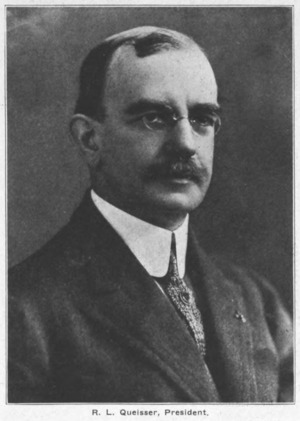
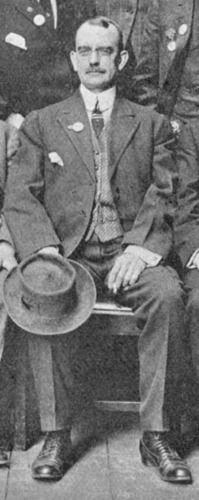
QUEISSER, Robert L.;1 pres. The Queisser-Bliss Co.; born, Indianapolis, Ind., Aug. 9, 1866; son of Julius and Caroline J. Schliebitz Queisser; educated, Indianapolis public and high schools; married, Springfield, O., Nov. 24, 1887, Jessie L. Fried; two sons, Charles Fried, and Robert L., Jr.; regimental adjutant, 3rd Regiment Inf. O. N. G.; battalion adjutant 7th Regiment Inf., O. N. G.; captain commissary, 5th Regiment Inf., O. N. G.; aide-de-camp on staff of Gov. Judson Harmon, four years; former pres. Chamber of Commerce, Zanesville; spent early life in railroad work, leaving a responsible position in the traffic department of The Baltimore & Ohio R. R. to become mgr. of The Ohio Press Brick Co., of Zanesville, one of the subsidiary companies of the Hydraulic Press Brick Co., of St. Louis, Mo.; remained with that company five years, when with William H. Hunt and C. A. Bliss,2 organized The Hunt-Queisser-Bliss Co., of Cleveland, and entered the brick and builders supply business; three years ago, acquired Mr. Hunt’s interest in the Company, and the corporate name was changed to the Queisser-Bliss Co.;3 past pres. Brick Building Ass’n of America;4 sec’y Ohio Face Brick Manufacturing Ass’n; sec’y-treas. The Face Brick Dealer’s Ass’n of America;5 pres. and mgr. The Queisser-Bliss Co.; Past Exalted Ruler, Springfield, O., Lodge, No. 51, B. P. O. Elks of the U. S.; member Emanuel Lodge, No. 505, F. & A. M.; McKinley Chapter, R. A. M., Past Grand Esteemed Leading Knight, B. P. O. Elks of the U. S.; Past Comander [sic], Coeur de Lion Commandery, Knights Templar. Past Vice Regent Snark of Ohio Concatenated Order of Hoo Hoo [sic];6 director International Ass’n of Rotary Clubs;7 pres. Cleveland Rotary Club, 1913; member Athletic, City Club, Masonic Club, Shaker Heights Country Club, Automobile Club,8 and member and director (1914) Chamber of Commerce, chairman membership committee of the Chamber; member Cleveland Builders’ Exchange; associate member Cleveland Engineering Society.
1. The “L.” stands for Louis. Unreliable online sources state that he died 1939-04-02. The National Underwriter #20, 1940-05-17, part 2, page 39, indicates his life insurance policy was paid out in 1939.
2. Clayton A. Bliss (1871–1943). See the Cleveland Directory, August 1910, page 143.
3. Twelfth floor, Schofield Building. Facing brick, terra cotta, and builders’ specialties (Cleveland Chamber of Commerce Annual Report 1917). Sometime between October 1916 and August 1917 (Cleveland Engineering Society Annual Directory 1917), it became just the “R. L. Queisser Co.,” at the same address. The company existed as late as 1930 (Cleveland Buyers Guide 1930).
4. Elected 1911. See his inaugural speech in the Brick and Clay Record 38(4), 1911-02-15, pages 206–210. The two photographs at the top of this section are from that issue.
5. December 1914. See Brick and Clay Record 45(11), 1914-12-01, page 1084.
6. As member #5097 of the Concatenated Order of Hoo-Hoo, Queisser served as Snark and Vicegerent for Ohio (Northern District) at least from November 1899 to July 1900. See his circular in the Hoo-Hoo Bulletin of November 1899, and his photograph in the Bulletin of August 1900.
7. See The Rotarian 3(2), October 1912.
8. In 1914 on the Membership Committee of the Cleveland Automobile Club, publishers of The Ohio Motorist magazine.
From the Brick and Clay Record 55(3), 1919-07-29, page 233:
Mr. Queisser, while a captain in the Ohio National Guard, saw active service at El Paso while guarding the Mexican border during the troubles 1916–1917.
From the Proceedings of the Ohio Society of New York 1919, pages 79–82:
President Herrick said: “[...] I would like to call upon a member of this Society, a new member who does not know that he is to be called upon. But before I do so, I would like to call your attention to this Service Flag. Over fifty members of this Society have entered the service and you will note at the top the two golden stars. The record of this Society is one, I am sure, we are proud of and I think in all seriousness, after the pleasantries about the treasury, that we would all have been very much ashamed if we had not contributed liberally from this treasury for war purposes. The gentleman whom I desire to call upon is a new member; I believe he is from Cleveland. You will recall that from Cleveland the carrier system came,— the citizens of Cleveland suggested and inaugurated a carrier system; also a citizen of Cleveland designed the mail catchers in the early days. Now, Robert L. Queisser has designed the Service Flag which has been in evidence in the windows of homes throughout this land and I should be pleased to have him stand up and say a few words, if he will. (Applause.)
Mr. Queisser said: “Mr. President and gentlemen of the Ohio Society. This is as the honored president has said; I came here tonight at the solicitation of my friend Mr. Ditto [Peter W. Ditto, chair of the membership committee], expecting to take a back seat at some little table. Imagine my surprise and the shock to my nervous system when I found that I had been delegated to sit at the table of the president in this distinguished company. And then, to cap the climax, to be asked to say something without any preparation, and I feel like the answer of the boy when he was asked: ‘Does your sister sing?’ He said: She does, but she can’t.’ (Laughter.) A year ago this month one of the distinguished pastors of the City of New York in a sermon which he preached, said that to his mind the conception of the Service Flag was distinctly an inspiration from on high,— and he being a member of the cloth, of course, I cannot take any exception to what he said. (Laughter.) If that be so, there is no credit particularly due and I have only been the instrument that has caused the production of the thought which has given to the people of this country that flag which has solaced the hearts of wives and the mothers and the sisters and the women of this country, not to forget that it has made proud the hearts of the fathers and those who have sent their best beloved into the service. If the invention or the institution of this flag has been of any value, I am immensely repaid.
“Hundreds of poems have been written about this flag and one woman poured out her heart in these lines:
“A square of red, a strip of white, One little star of blue, Is hanging beside the doorway That is home for me and you.
Our boy has gone, he is over there, He is all we had to give, Our only son scarce twenty-one, He had just begun to live.
We are lonesome now, and when last night I laid my knitting up, I sobbed a silent prayer for him While gazing at the sky.
Great Saturn shone, Vega blazed in glory, But I know the heavens do not own an orb so great As that one star of blue.”
(Applause.)“Some have been good enough to say that the Service Flag has been a potent factor in engendering a better and a more willing feeling of sacrifice. That it has been the symbol,— the visible symbol of those who have given themselves and offered themselves on the altar of human liberty. Not only that, but it represents those who have sacrificed everything in going to the front and offering themselves in their ideal of world democracy. It has been a great pleasure to me during the past year in the travels that I have had throughout this country to see that flag in practically every city and hamlet through which I passed, and I am, perhaps, taking into consideration what the good reverend said in this city, that it was an inspiration, more proud of one fact: I offered that flag,— I went to Washington, offered it to the government, was ridiculed, told it had absolutely no merit, that it would have no place in the annals of the war department, and in the face of the utmost discouragement, with my good wife to help me, I started on a six months’ propaganda. The result is self-apparent; I put it across. (Applause.)
“I feel that, perhaps, some of you men would care to see the first flag that ever flew; I expect to show it Sunday night in a church in this city, so that some day in the future you can say you had,— I do not know whether you would call it the pleasure,— but there is the first flag. (Applause.) I appreciate the opportunity of being here tonight and I want to express my thanks to my good friend Ditto in insisting I place my application with you. I assure you I shall go away from here with the happy appreciation of a very pleasant evening spent in the company of ex-Ohioans." (Long applause.)
Mr. Kennedy said: “May I just say one word? The two stars on that flag are the captain’s only sons who were among the earliest volunteers. He did not mention that.” (Applause and cheers.)
This speech was briefly paraphrased in “Tells of Service Flag: Inventor, at Ohio Dinner, Describes Rejection by War Department,” New York Times, 1918-11-30, page 4. That article is quoted in “Propaganda Did It,” Advertising & Selling 28(14), 1918-12-07, page 28.
Ohio Senate Resolution 60. In the Journal of the Senate, 93rd General Assembly of the State of Ohio, volume 118 pages 864–865. For the date 1939-06-01.
Mr. Zoul offered the following resolution:
S. R. No. 60—Mr. Zoul [William J. Zoul, of Cleveland].
Relative to the death of Col. R. L. Queisser, of Cleveland, Ohio.
Whereas, In the death of Col. R. L. Queisser, of Cleveland, Ohio, an outstanding figure of Cleveland Heights and Cuyahoga county, has gone to his eternal reward; and
Whereas, Col. Queisser was prominently identified with fraternal work, a thirty-second degree Mason, the colonel had belonged to the Masonic order for forty-seven years. He was a past grand commander of the Knights Templars of Ohio, past commander of Couer de Leon [sic] commandery, Knights Templar, past high priest of the Windermere Masonic chapter, past master of the Windermere council and former president of the East Cleveland Masonic Temple Co. He held membership in the Benevolent and Protective Order of Elks for fifty-two years, and became grand esquire of the order; and
Whereas, Col. Queisser was a former president of the Cleveland Rotary club, the past national commander of the National Sojourners, whereby he became internationally known; and
Whereas, Colonel Queisser was a former captain of the Fifth Ohio infantry of the Ohio national guard and served in the Mexican border campaign of 1916. For four years he was aid-de-camp on Governor Judson Harmon’s staff; and
Whereas, As an East Cleveland councilman he was instrumental in establishing Shaw park, and assisted in beautifying the suburb. He was president of the East Cleveland council, in which he served two terms from 1912 to 1916; and
Whereas, Colonel Queisser, at the beginning of the world war designed and invented a flag, which flag (for the first time in history) was called a “service flag.” The said service flag was designed, authorized and first used in Cleveland, and was officially authorized and adopted by the United States war department as per memorandum issued by Col. Nathan William MacChesney, department judge advocate, central department, Chicago, and published in the official bulletin January 21, 1918, volume 2, No. 213; and
Whereas, On March 27, 1935, the 91st General Assembly of Ohio adopted a joint resolution, by virtue of which Robert L. Queisser was commissioned a colonel by the governor of Ohio; and
Whereas, Colonel Queisser’s two sons served in the world war, one of his sons finally attaining the rank of lieutenant colonel and the other the rank of major; therefore be it
Resolved, That the members of the Senate of the 93rd General Assembly honor and revere the memory of Col. R. L. Queisser of Cleveland Heights and as a further mark of respect that this resolution be adopted by a rising vote and a copy thereof be spread upon the journal; and be it further
Resolved, That a properly authenticated copy of this resolution be forwarded by the clerk of the Senate to the members of the family of the deceased.
The question being on the adoption of the resolution.
So the resolution was adopted.