
Branchless sorting of trivially relocatable types
A few days ago Christof Kaser posted a very impressive blog post on
“Fast Branchless Quicksort using Sorting-Networks”
(chkas/blqsort). A “branchless” algorithm is
one designed to exploit modern processors’ conditional-move instructions. So for
example the blqs::sort2 primitive, which looks like this:
template<class T, class Compare>
void sort2(T& a, T& b, Compare comp) {
  T x = a;
  T y = b;
  bool m = comp(x, y);
  a = m ? x : y;
  b = m ? y : x;
}
when instantiated for int compiles down to a couple of cmov instructions on x86-64
and a couple of csel instructions on ARM64. (Godbolt.)
But at the higher generic-programming level, count all the copy operations in sort2!
It copies a into x; then copy-assigns x back into a. If T were an expensive-to-copy
type like std::string, this would be slow code; and if T were unique_ptr, it wouldn’t
compile at all. Therefore, blqsort enables its entire branchless “fast path” only for
types that are trivially copyable and roughly register-sized.
As of this writing the gating condition is
std::is_trivially_copyable<T>::value && sizeof(T) <= 16, but I’ve pointed out to Christof that hisheap_sortalso depends onTto be trivially default-constructible. It’s also possible (if pathological) forTto be trivially copyable yet not copy-constructible or (more commonly) not copy-assignable. But this blog post isn’t really about narrowing the gate; we’re going to broaden it instead!
“Trivially copyable” is what I call a “holistic” trait: it means something about the behavior of the entire type, rather than about just one special member function or just one kind of expression. And specifically what it means is that you can do any value-semantic operation — bringing new copies into existence, poofing them out of existence, overwriting one’s value with another’s, swapping or permuting or copying — as if the objects were just bags of bits. As long as you never try to invent a new value out of whole cloth, you can shift copies of your given values around as much as you like, even into completely new areas of memory, simply by memcpying them. In the following diagram, each box represents a C++ object, and the color of the box represents the object’s value (for example 42, or 3.14, or “hello,” or Tuesday).
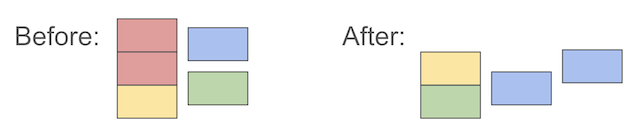
We see that in the “After” picture, the green object has become blue. Was that by copy-assignment from the original blue object? or move-assignment? or copying from the yellow, destroying, and then copy-constructing from a blue object? With trivial copyability, we needn’t say! Each of those possible operation-sequences is guaranteed to be physically tantamount to simply memcpying the “blue” bytes into their final location.
“Trivially relocatable” (the widely deployed P1144 idiom, I mean, not the unusable version that was briefly merged into the C++26 draft in 2025) is another “holistic” trait. Specifically what trivially relocatable means is that you can do any affine value-semantic operation — swapping, permuting, relocating from one place to another — as if the objects were just bags of bits. As long as you preserve the number of copies of each given value, you can shift that particular set of values around as much as you like, even into completely new areas of memory, simply by memcpying them. (But unlike two paragraphs ago, with trivially relocatable you’re not allowed to turn one value into two, or poof a value completely out of existence: each and every input value must be represented the same number of times in the final output.)
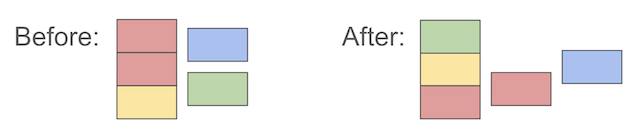
As long as whatever highest-level algorithm we’re doing preserves this “affine,” one-to-one property, every possible operation-sequence is guaranteed to be physically tantamount to simply memcpying the bytes around.
The above images come from a ten-slide presentation on holistic traits I wrote in mid-2024. See the whole slide deck here.
Algorithms that have this “affine” one-to-one property include swap, rotate, partition, and… sort!
Imagine rewriting blqs::sort2 like this (Godbolt):
template<class T, class Compare>
void sort2(T& a, T& b, Compare comp) {
  union U { T t; U() {} ~U() {} };
  U x, y;
  std::relocate_at(&a, &x.t);
  std::relocate_at(&b, &y.t);
  bool m = comp(x.t, y.t);
  std::relocate_at(m ? &x.t : &y.t, &a);
  std::relocate_at(m ? &y.t : &x.t, &b);
}
This is conceptually closer to what our sort2 algorithm actually “needs” to do.
It doesn’t really care that it’s making copies of T objects; conceptually it’s just
bringing the values “closer to hand” (which could be a relocate), comparing its close-up
copies, and then putting the values back “in memory” (which could be a relocate). For
trivially copyable T, it’s totally fine to replace the first relocate with a copy-construct
and the second relocate with a copy-assign: the end result is guaranteed to be the same,
assuming it compiles at all. The relocation-based version merely extends that guarantee
from “trivially copyable T” to “trivially relocatable T.”
But the above code both depends on P1144/P3516 relocate_at and is super ugly.
Imagine patching every helper in blqsort.h with this pedantry! We can actually
achieve the same effect much more easily by leaning on the holistic guarantee: We know
that the end result of sort2 — in fact the end result of blqsort — will be an affine,
one-to-one, permutation of the input values. So we can actually run the whole algorithm
working entirely with object representations! The patch for this is only a few lines long:
  constexpr bool copy_is_cheap =
    std::is_trivially_copyable<T>::value && sizeof(T) <= 16;

+ constexpr bool relocate_is_cheap =
+   std::is_trivially_relocatable<T>::value && sizeof(T) <= 16;

  if constexpr (copy_is_cheap) {
    blqsort(first, last - 1, comp);
+ } else if constexpr (relocate_is_cheap) {
+   struct Rep {
+     alignas(T) char data_[sizeof(T)];
+   };
+   blqsort((Rep*)first, (Rep*)(last - 1),
+     [&](const Rep& a, const Rep& b) { return comp(*(const T*)&a, *(const T*)&b); });
  } else {
    block_qsort(first, last - 1, comp);
  }
This says, “If we know that T is trivially relocatable, then let’s just pretend we’re sorting
anonymous blocks of bytes instead. Make sure to treat them as T objects for the purposes
of comp, but don’t worry about the value-semantic bookkeeping; I promise it will all come out
correctly in the end.”
Christof’s blqs::sort uses the branchless fast path, blqsort, only for trivially copyable
types; types that don’t make it through that gate will use the slow path, block_qsort, instead.
This patch broadens the gate: now we can use the fast path for all trivially relocatable types,
including for example unique_ptr and shared_ptr. (But not string, because it fails the
sizeof check.)
Benchmark results
This turns out to be a perfect testbed for the kinds of performance improvements you can get
from P1144-style trivial relocation on something as familiar as sorting a vector of shared_ptr.
I wrote a benchmark (backup) comparing the performance
of the high-level blqs::sort on four different kinds of T:
struct TC {
  Int *p_;
  void *ctrl_;
  explicit TC() = default;
  explicit TC(Int& i) : p_(&i) {}
  friend auto operator<=>(const TC& a, const TC& b) { return *a.p_ <=> *b.p_; }
};

struct TR {
  std::shared_ptr<Int> p_;
  explicit TR() = default;
  explicit TR(Int& i) : p_(&i, [](Int*){}) {}
  friend auto operator<=>(const TR& a, const TR& b) { return *a.p_ <=> *b.p_; }
};

struct NTC : TC {
  using TC::TC;
  ~NTC() {}
};

struct NTR : TR {
  using TR::TR;
  NTR(NTR&&) = default;
  NTR(const NTR&) = default;
  NTR& operator=(NTR&&) = default;
  NTR& operator=(const NTR&) = default;
  ~NTR() {}
};
TR is a Rule-of-Zero type that pays all the same costs as shared_ptr
for its value-semantic operations — yet it is trivially relocatable. Then NTC is
exactly the same as TC except that its no-op destructor makes it not-trivially-anything;
and NTR is exactly the same as TR (paying shared_ptr costs) except that its no-op
destructor makes it not-trivially-anything.
Sorting a vector of 50 million elements with Christof’s (current) implementation of
blqs::sort out of the box shows TC taking the fast path and all three of
TR, NTC, NTR taking the slow path, as predicted. Here the “std::sort” column
refers to libc++’s current implementation.
| Type | std::sort |
blqs::sort |
Savings |
|---|---|---|---|
TC |
5.9s | 3.5s | 41% |
TR |
6.5s | 6.2s | 4% |
NTC |
5.8s | 4.3s | 25% |
NTR |
6.3s | 6.7s | −6% |
Now we apply the patch above, to enable the fast path whenever relocate_is_cheap.
The numbers for TC, NTC, and NTR aren’t expected to change; so you can see
roughly how noisy this microbenchmark is.
| Type | std::sort |
blqs::sort |
Savings |
|---|---|---|---|
TC |
5.8s | 3.4s | 42% |
TR |
6.5s | 4.0s | 38% |
NTC |
5.8s | 4.4s | 24% |
NTR |
6.2s | 6.3s | −2% |
That is, by applying an eight-line patch to use the fast path for trivially relocatable
shared_ptr, we’ve turned blqs::sort from a 4% win into a 38% win, right in line
with its speedup for trivially copyable types.
What gave us this speedup?
To get this speedup, we used one “dirty trick” and one compiler extension. Our dirty trick was:
struct Rep {
  alignas(T) char data_[sizeof(T)];
};
blqsort((Rep*)first, (Rep*)(last - 1),
  [&](const Rep& a, const Rep& b) { return comp(*(const T*)&a, *(const T*)&b); });
Those casts are reinterpret_cast in disguise. This is type-punning, and
technically it’s undefined behavior. (It’s certainly not constexpr-friendly.)
We can make it well-defined and constexpr-friendly by using the P1144/P3516
entrypoint std::relocate_at on T objects instead of copy-assignment on Rep
objects; but as we’ve seen, that’s very ugly — and in fact very error-prone.
Changing a copy-assignment-based algorithm to use relocation takes a major
code audit to make sure you balanced out every construction and destruction, never
moved or relocated twice from the same object, never accessed an object outside
its lifetime, etc. Our “dirty trick” foolproofly accomplished the same codegen,
with just a little surgical patch at the top level. If we really needed constexpr-friendliness,
I’d add an if consteval at the top level sooner than I’d give up this trick.
But of course the thing we must have, in order to apply this optimization,
is a reliable way to detect is_trivially_relocatable<T>. My code makes it look
easy, because I use a compiler (and standard library) with full P1144 support.
Sadly neither Clang nor GCC is such a compiler.
Mainline Clang actually has two
different builtins in this area — __is_trivially_relocatable and
__builtin_is_cpp_trivially_relocatable — but both of them have too many false
positives to use safely in production: the latter by design (it intended to
implement the failed P2786 proposal) and the former merely by neglect. An attempt
was made to fix up the former in Clang #84621,
but the maintainers resisted, and the patch was eventually abandoned.
Obviously I’d like to see it revived.