
Some recent discoveries
First images of PHerc. 1667. When Vesuvius buried Herculaneum, it turned many papyrus scrolls in the Villa dei Papiri to burnt hunks of carbon without destroying their physical structure. Since the 2010s (or earlier?), people have tried to non-invasively image what remains of the scrolls. In June 2026, the latest “Vesuvius Challenge” prize was awarded to a team who successfully imaged the first “complete” scroll. The team’s report (“Complete virtual unwrapping and reading of a rolled Herculaneum papyrus”, Angelotti et al., 2026) points out that the scroll is even less “complete” than it used to be: invasive efforts in the late 20th century had already reduced it from about 14 grams of carbonized gunk to about 6 grams. The group’s full transcription consists of only 300 to 400 complete words. They identify PHerc. 1667 as some sort of philosophical treatise — unsurprising, as many of the scrolls that could already be deciphered turned out to be works of Philodemus. Contrary to some media reports, the title of PHerc. 1667’s work is unknown; but a separate finding reported in the same paper identifies PHerc. 139 as book 8 of Philodemus’s On gods (περὶ θεῶν, book Η).
Three lost songs from Iolanthe. In April 2026, Marc Shepherd was looking at a manuscript full score of Gilbert & Sullivan’s Iolanthe in the British Library (MS Mus. 1824/1/7/4) and discovered at the back of the manuscript the orchestra parts for these three songs, all cut from Iolanthe before the end of its run and up to now believed about as lost as Thespis:
- “On you they’d set a coronet” (Phyllis, Tolloller, Mountararat, Lord Chancellor)
- “My love for him is dead” (Phyllis)
- “De Belville was regarded as the Crichton of his age” (Mountararat)
More information can be found in Shepherd’s transcription of the full score; in his blog post “Three Deleted Songs from Iolanthe” (May 2026); and in a two-hour video interview with William Remmers, the music director of New York’s Utopia Opera. Utopia Opera has already put recordings of all three songs on YouTube.
Shepherd remarks that Phyllis is a soprano without an aria; the deleted song would naturally have been her big number. But Act II already has its share of wishy-washy love songs — “You plead in vain,” “Oh foolish fay” — and “My love for him” must have seemed too samey. Mountararat, meanwhile, is coming straight from his three-verse comic song “When Britain really ruled the waves”; it doesn’t make much sense to give him a second three-verse comic song in the same act! Still, Gilbert liked “De Belville” per se so much that he republished its words in Songs of a Savoyard (1890); it was only Sullivan’s melody that was lost.
Shepherd is also the coauthor of The Variorum Gilbert & Sullivan, Volume 1 (2015) and has edited the full scores of many of the operettas. The most interesting parts of the Utopia interview, for me, were in the first 15 minutes where Shepherd talks about his ongoing projects (including volumes 2–5 of the Variorum); and circa an hour in, where they discuss the importance of a well-edited score and the crazy things one does when one is lacking. The former reminds me that I have plenty of unfinished projects of my own. For example, after I wrote “In search of Adventure ]I[” (2023-01-09) I did actually receive a playable version, which I haven’t gotten around to blogging about yet; nor have I yet written a post about my online collection of John Philip Sousa operettas. The latter reminded me of what George Bernard Shaw said in the third edition of The Perfect Wagnerite:
It is possible to learn more of the world by producing a single opera, or even conducting a single orchestral rehearsal, than by ten years reading in the library of the British Museum.
Yet another proposed decipherment of Linear A. Via Hacker News: “Amateur linguist” Tom di Mino proposes that the Linear A script of Minoan Crete encodes a spoken language from the Semitic family, and claims to have a list of phonetic values that make sense of at least one inscription. He announced the news via LinkedIn and via Stephen Kosloff’s AI-themed blog, which are weird venues: weird enough to attract attention from hackers with Gell-Mann amnesia, for sure.
I hadn’t yet heard this news when I posted “Katakana and Cypriot” (2026-06-12); that was just serendipity. But on that note I observe that you can find some autodidacts (and even allodidacts) who unironically claim that Linear A encodes spoken Japanese; notably Gretchen E. Leonhardt and Mizuhiro Kuroda. Needless to say, it does not.
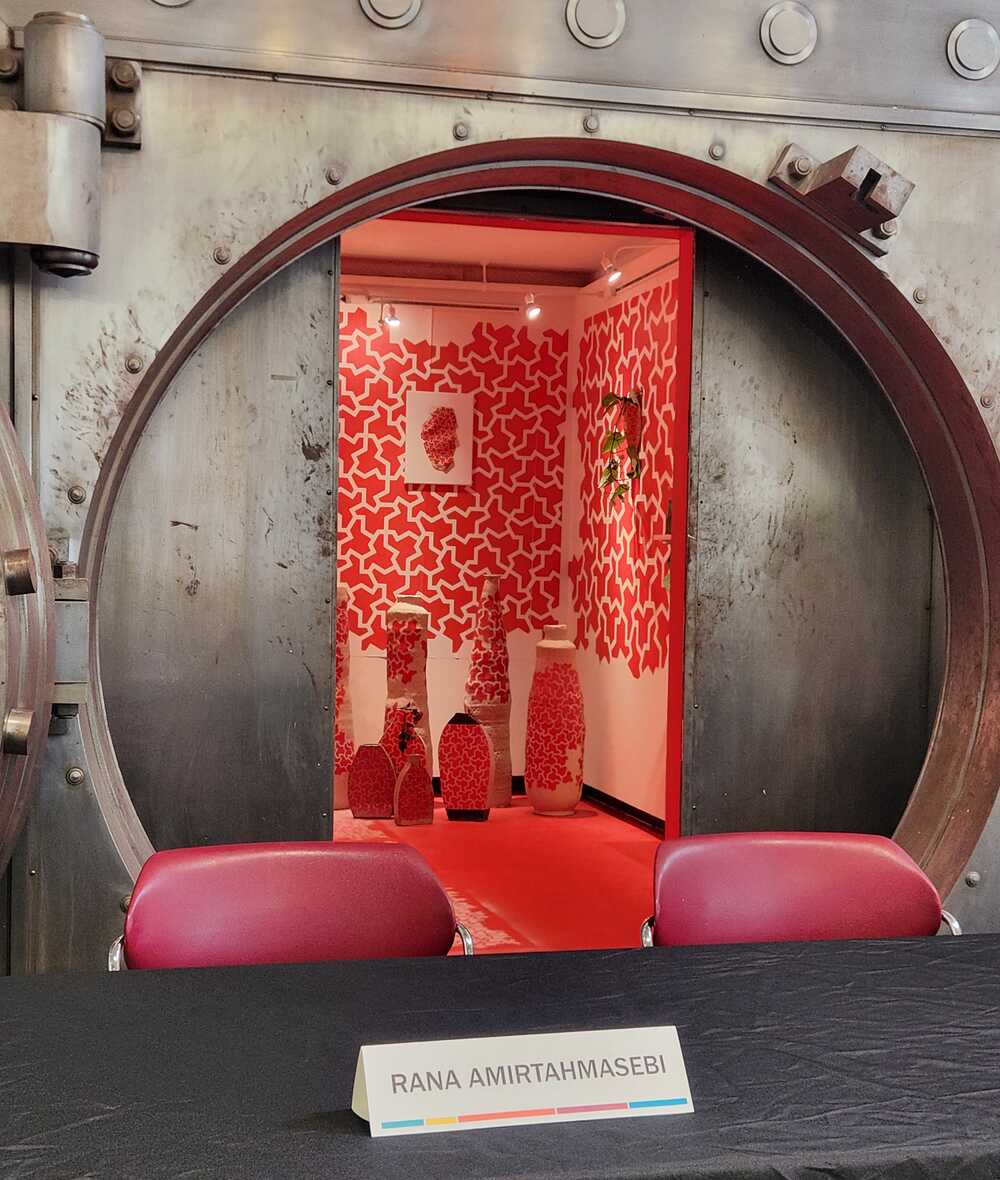
Hat sighting in the wild. Last week I visited ArtsWestchester in White Plains, New York, which is housed in a former bank and occasionally uses its armored vault for art installations. This month it’s Rana Amirtahmasebi’s “Continuum: Terra,” in which the artist covers various things (walls, floors, dishes) with the aperiodic monotile known as the “hat.” The hat itself is a recent discovery — it was first discovered in 2022 and announced publicly in March 2023.
ArtsWestchester’s official gallery page inexplicably displays an AI-generated image of some bullshit, rather than Amirtahmasebi’s actual work. What, does nobody at ArtsWestchester own a camera? Top: ArtsWestchester’s AI slop. Middle and bottom: The real-life vault, with hat pattern.
 |
 |
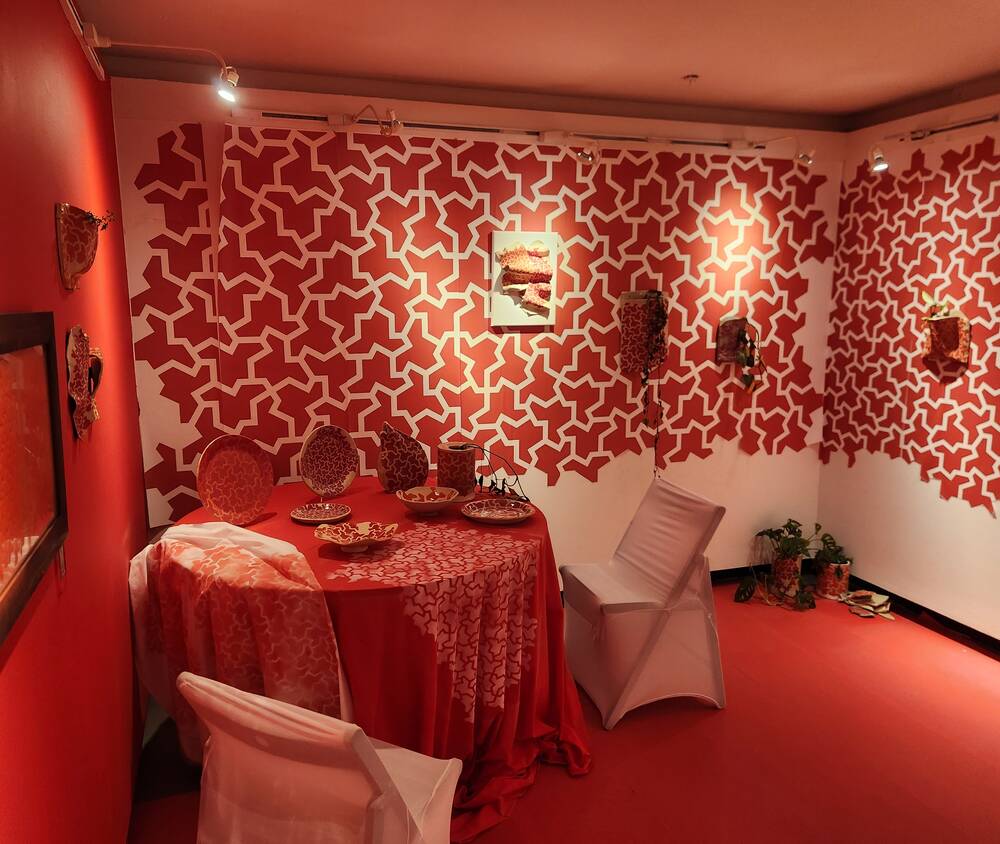 |
Now, the hat will tile the plane, but you’ll have trouble tiling a curved surface (such as Amirtahmasebi’s lumpy pottery). Her solution was in some cases to deform or truncate the hat, and in other cases to just give up and stop tiling. It wasn’t mathematically satisfying at all. But I liked seeing the hat in the wild, anyway.
See also:
- “Two-Minute Iolanthe” (2026-05-08)
- “Escheresque parquet deformations of an aperiodic monotile” (2023-03-30)