
Colourfields
Over on the (inexplicably login-walled) site “NewEnigma,” Keith Austin writes:
Draw a 4-by-4 grid. Colour each square red or blue. Select any square, S, and write 1 in it. Then write 1 in every square you can reach from S by a series of moves, where each move is from a square to an adjacent, horizontally, vertically, or diagonally, square of the same colour.
Select any empty square, T, and write 2 in it. Then write 2 in every square you can reach from T by a series of moves. Repeat this procedure for 3 and then 4 and so on until every square has a number. The last number you write down is called the “score” for that colouring. If we imagine the grid is the map of a farm, then you have divided the map into fields, one field for each number.
(1) What is the largest score possible?
(2) If we work with a 5-by-5 grid, what is the largest score possible?
In brief: What is the maximum number of queenwise-connected monochromatic regions you can make by coloring each square of an \(n\times n\) grid either red or blue? If we were asking about rookwise-connected regions, the answer would obviously be \(n^2\). But queenwise-connected is at least slightly less obvious!
For the 5-by-5 grid, the “obvious” answer is
rBrBr
BBBBB
rBrBr
BBBBB
rBrBr
for a total of 10 regions. But the answer for 4×4 is not simply
rBrB
BBBB
rBrB
BBBB
for a total of 5; you can in fact make 6 regions! (Once you’ve seen the trick it’s hard to unsee; but I didn’t see it at first myself.)
Discussion on the SeqFan mailing list tentatively produced the sequence: 1, 2, 5, 6, 10, 12, 17, 19, 26, (28?)… Here’s the pattern for odd \(n\), and a conjectured pattern for all even \(n>4\).
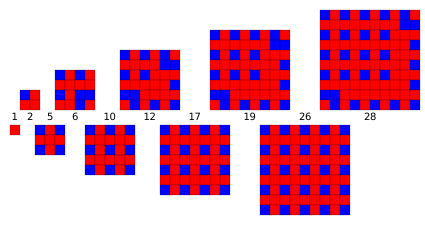
For odd \(n\): \(\lceil n/2\rceil^2 + 1\) regions. For even \(n>4\): \(\lceil n/2\rceil^2 + 3\) regions.